
What is retainage in construction?
Retainage is the 5% or 10% of each progress payment held back until a job is finished. Here is how it is calculated, a worked pay app example, why it hits contractor cash flow, and the mistakes that leave money on the table.
What is retainage?
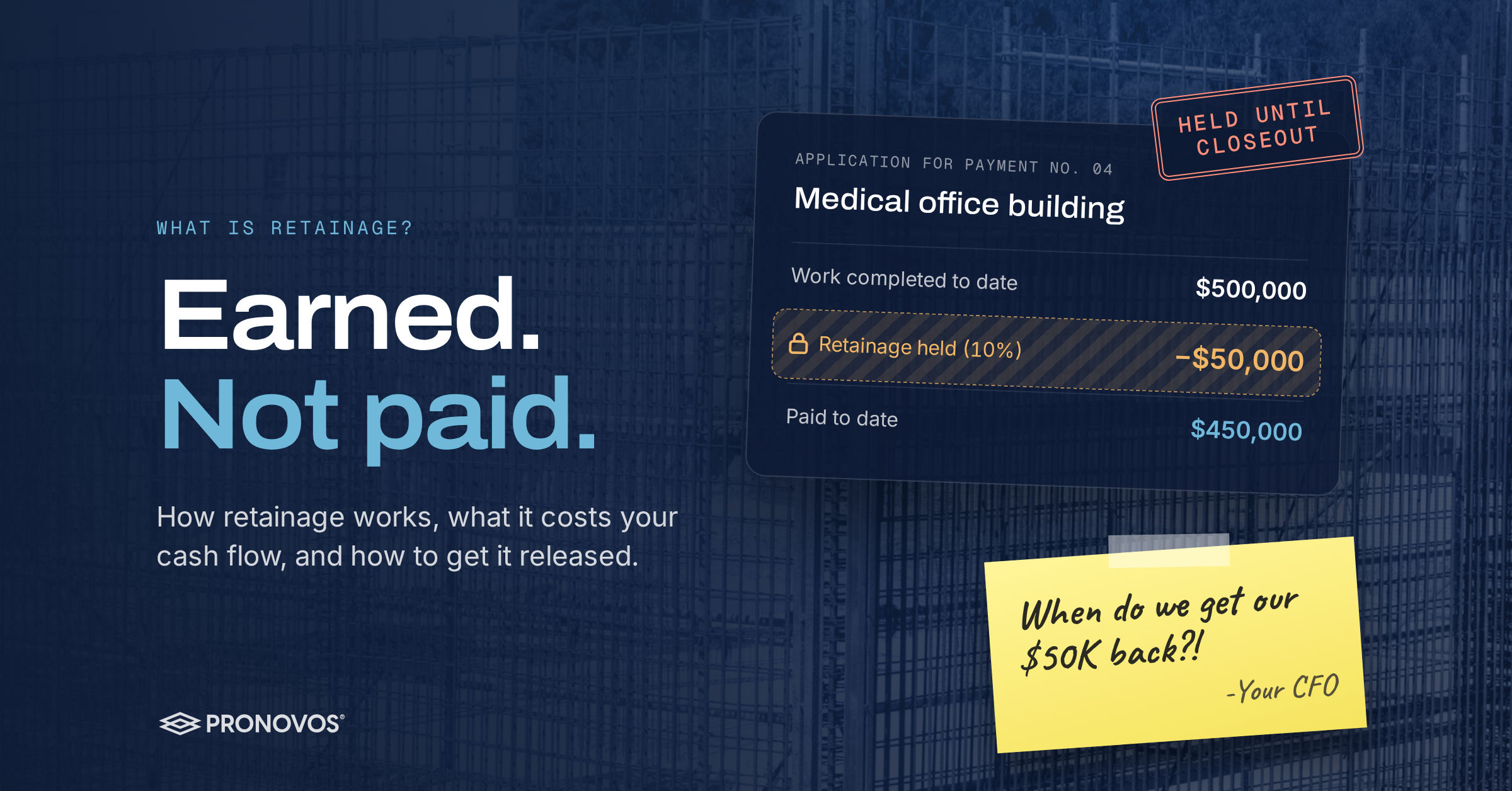
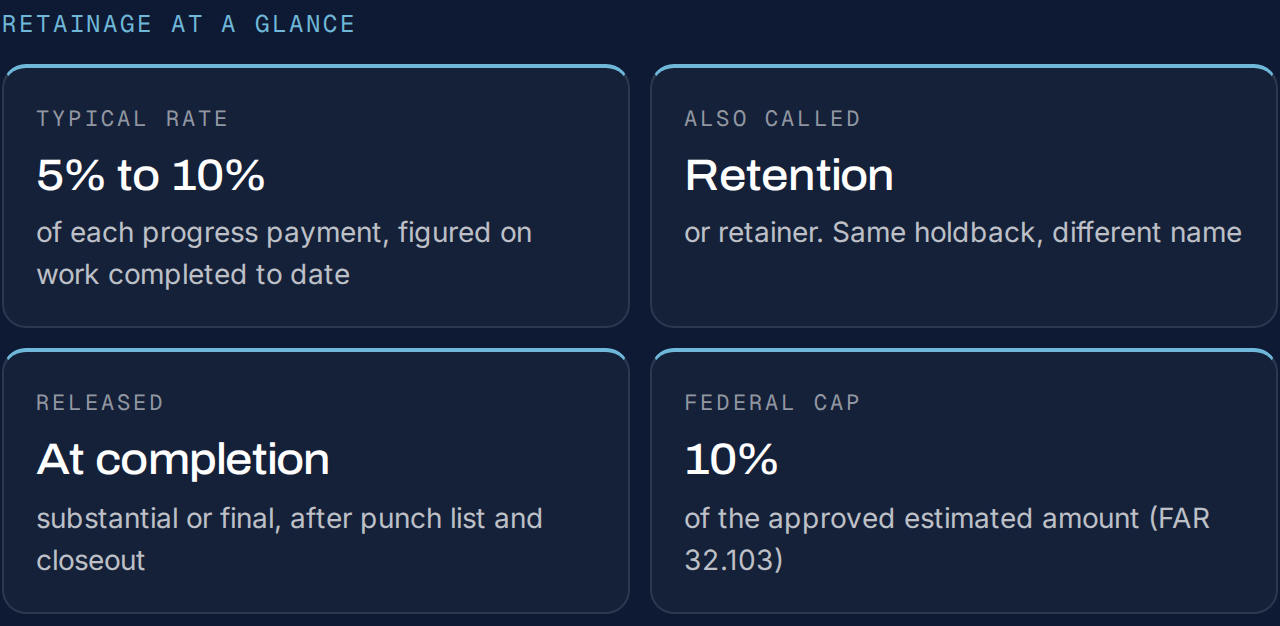
Retainage is a portion of each progress payment that the owner or general contractor holds back until the work is complete. It is usually 5% or 10% of the work billed to date. The money is earned but not yet paid, and it is released at substantial or final completion once the punch list and closeout items are done.
Retainage is also called retention or retainer. Owners use it as security that the job gets finished. General contractors often pass the same holdback down to their subcontractors.
How retainage works
Retainage is figured on the total work completed to date, not just this month's billing. On an AIA-style pay app (G702 and G703), the holdback is calculated line by line on the continuation sheet and rolled up to the summary page. Stored materials usually carry the same rate, as James Moore's guide to billing retainage on AIA forms explains.
Two formulas do the work. Retainage to date equals work completed to date times the retainage rate. Amount due this period equals work completed to date, minus retainage to date, minus previous payments.
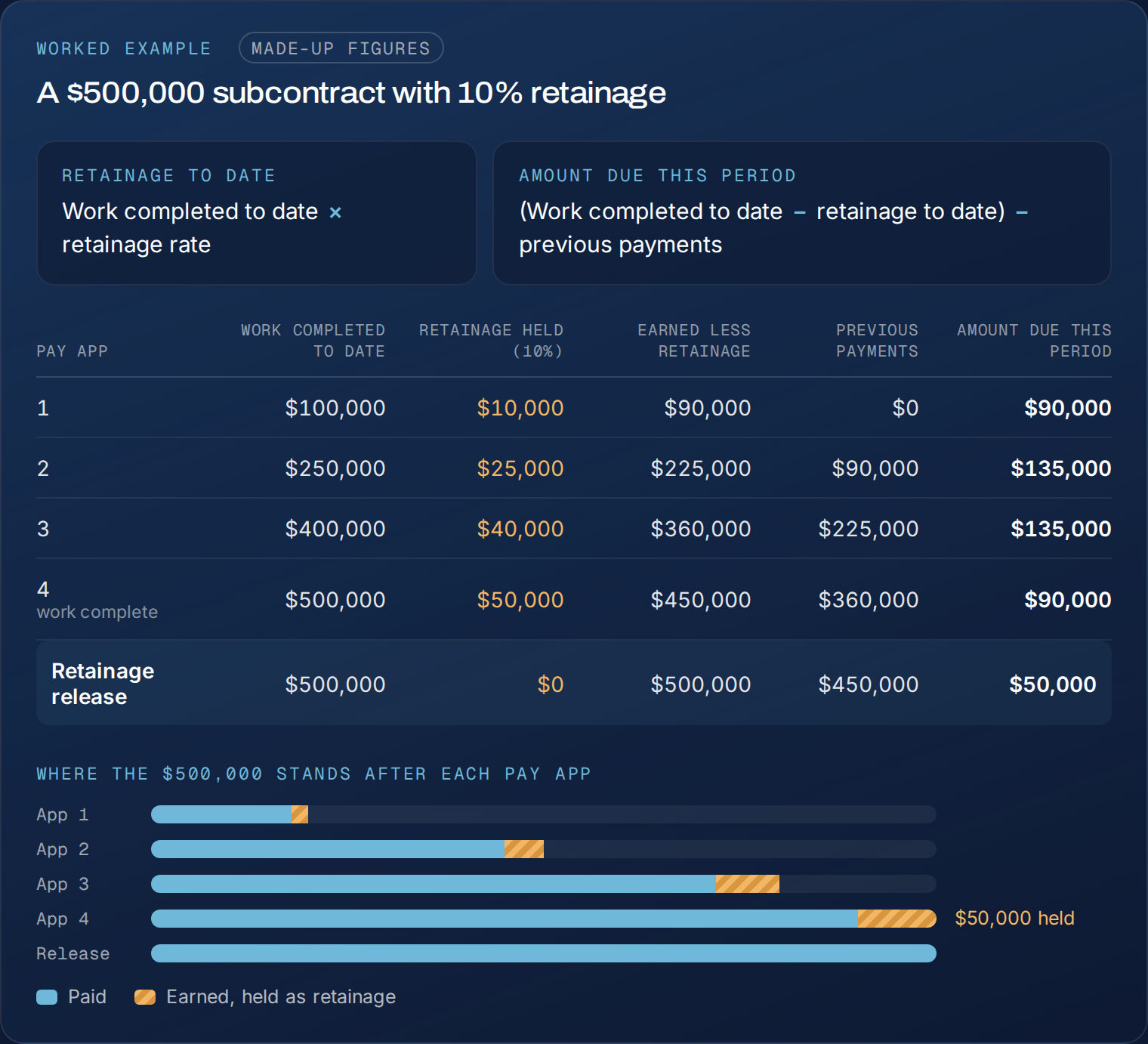
In this example, a subcontractor has a $500,000 contract with 10% retainage. The sub has completed all $500,000 of work after pay app 4 but has been paid only $450,000. The last $50,000 is on hold pending release, which can come weeks or months later.
Some contracts cut the rate partway through, for example, from 10% to 5% at 50% complete. When that happens, the next pay app shows the lower rate.
Why retainage matters for contractors
Retainage is your money, paid late. You have already paid the crew, the suppliers, and the equipment bills for that work. Someone else holds the holdback until closeout.
It can exceed your profit. If your margin on a job is under 10%, a 10% holdback can exceed the entire profit on that job. Until release, the job can be cash negative even when it is profitable on paper.
It stacks down the tiers. The owner holds from the GC, the GC holds from subs, and subs may hold from their own subs. Trades that finish early, like sitework or foundations, can wait the longest because release usually follows completion of the whole project.
It shows up on your balance sheet. Retainage receivable is an asset, and retainage payable is a liability. Track both apart from regular AR and AP, so your aging reports and WIP tell the true cash story.
The rules change by contract and by state. Some examples:
Federal work: FAR 32.103 says retainage should not be used as a substitute for good contract management or withheld without cause, and it may not exceed 10% of the approved estimated amount.
New York: General Business Law 756-c caps retainage at 5% of the contract sum, requires release within 30 days after final approval of the work, and charges 1% per month interest on late release.
Many other states set their own caps and release deadlines, especially for public work.
Retainage rules vary by state, by public or private project, and by contract. This page is general information, not legal advice. Check your contract and your state's law, or ask a construction attorney.
Common retainage mistakes
Calculating it on this period only. Retainage is figured on cumulative work to date. Getting this wrong throws off every pay app after the first.
Not reading the reduction clause. If the contract drops the rate at 50% complete, nobody will lower it for you. Bill the new rate on the next pay app.
Forgetting to bill the release. Retainage does not show up on its own. Submit a release request with the closeout package, lien waivers, and warranties the contract calls for.
Lumping it into regular AR. Aged retainage with open invoices makes collections look worse than they are or hides overdue money.
Holding more from subs than the owner holds from you. Some states limit this. In New York, for example, retainage held from a sub can never exceed the percentage the owner actually retained.
Missing the release deadline. State prompt payment laws can set release deadlines and interest on late payment. Know the date and follow up when it passes.
Retainage FAQ
What is a typical retainage percentage?
Most contracts hold 5% or 10% of each progress payment. Some states cap it lower, and some contracts reduce it partway through the job.
When is retainage released?
Usually at substantial or final completion, after punch list and closeout items are done. Your contract and state law set the timing. In New York, for example, it must be released within 30 days after final approval of the work.
Is retainage the same as retention?
Yes. Retainage, retention, and retainer all mean the same holdback.
Can a GC hold retainage from subs if the owner does not hold it from the GC?
It depends on the contract and the state. Some states limit sub retainage to what the owner actually withheld. Check your subcontract and local law.
Does retainage count as revenue?
The work is earned, so you generally record retainage as revenue with a retainage receivable, even though the cash comes later. Confirm the treatment with your CPA.
How do I track retainage?
Keep retainage receivable and payable in their own accounts, by job. Note the rate, any reduction trigger, and the release date for each contract.
See your retainage and your cash in one place
Retainage is earned money you cannot spend yet. The fix is knowing exactly how much is held, on which jobs, and when it is due back.
Nova ties AR, AP, WIP, and cash flow to field activity, so you can act on AR aging. See how Nova tracks what you are owed
For subcontractors waiting on the GC's pay cycle, QuickPay Direct advances cash on unpaid invoices, funded the next business day.