fbpx

Published June 8, 2026 . 0 min read

The Three Pillars of Construction Cash Flow Every Contractor Needs to Understand

Construction cash flow is one of the most persistently misunderstood disciplines in the industry. There’s a myth that if your jobs are profitable, your business is healthy.

The numbers don’t always tell the full story. A project can show a 15% margin on paper while the bank account is running dry. Clients are slow to pay, material costs spike mid-project, and payroll doesn’t wait for progress payment approvals. Profit is a projection. Cash is what keeps the lights on.

The construction industry has a structural cash flow problem baked in. Money comes in slowly; payment terms average 60 to 90 days before approval delays push them even further. Expenses come out fast: labor every week, materials on delivery, equipment whether it’s moving or not. That timing mismatch is where most contractors run into construction cash flow problems, and it has nothing to do with whether the job is profitable.

Managing cash flow well comes down to three things: not accounting concepts, but operational priorities that determine whether a construction business survives, grows, and can absorb the unanticipated.

1
Pillar One

Operational Resilience

Before a shovel is even put into dirt, construction demands cash. Mobilization alone can consume 10 to 20% of a project’s total budget. Labor expects to be paid on schedule. Suppliers expect payment terms to be honored. And the timing mismatch between when money goes out and when it comes in creates constant pressure, even on well-run jobs.

The danger isn’t always visible. A contractor winning new work, keeping crews busy, and hitting project milestones can still find themselves in a cash crisis — because receivables are aging, expenses are accelerating, and reserves are thinner than anyone realized.

Consider what happens on a large project where the first billing is substantial — $300,000 or more — but payment doesn’t arrive for 60 to 90 days. Meanwhile, materials are delivered on day one, labor needs to be paid weekly, and vendors aren’t waiting for a GC’s approval cycle to run its course. That gap between invoice submission and payment arrival is where cash gets consumed fastest, and where well-run contractors get caught off guard.

The cycle only breaks when contractors have enough visibility to see it coming and enough options to cover it: reserves, a line of credit, or an early payment arrangement on approved invoices. The right tool depends on the size of the gap and what’s at stake. The point is to have the options lined up before the gap appears, not after.

Operational resilience means having the cash position and the visibility to keep operations running through the unexpected — not just when everything goes to plan.

✓  What it requires
Weekly cash flow reviews, not monthly
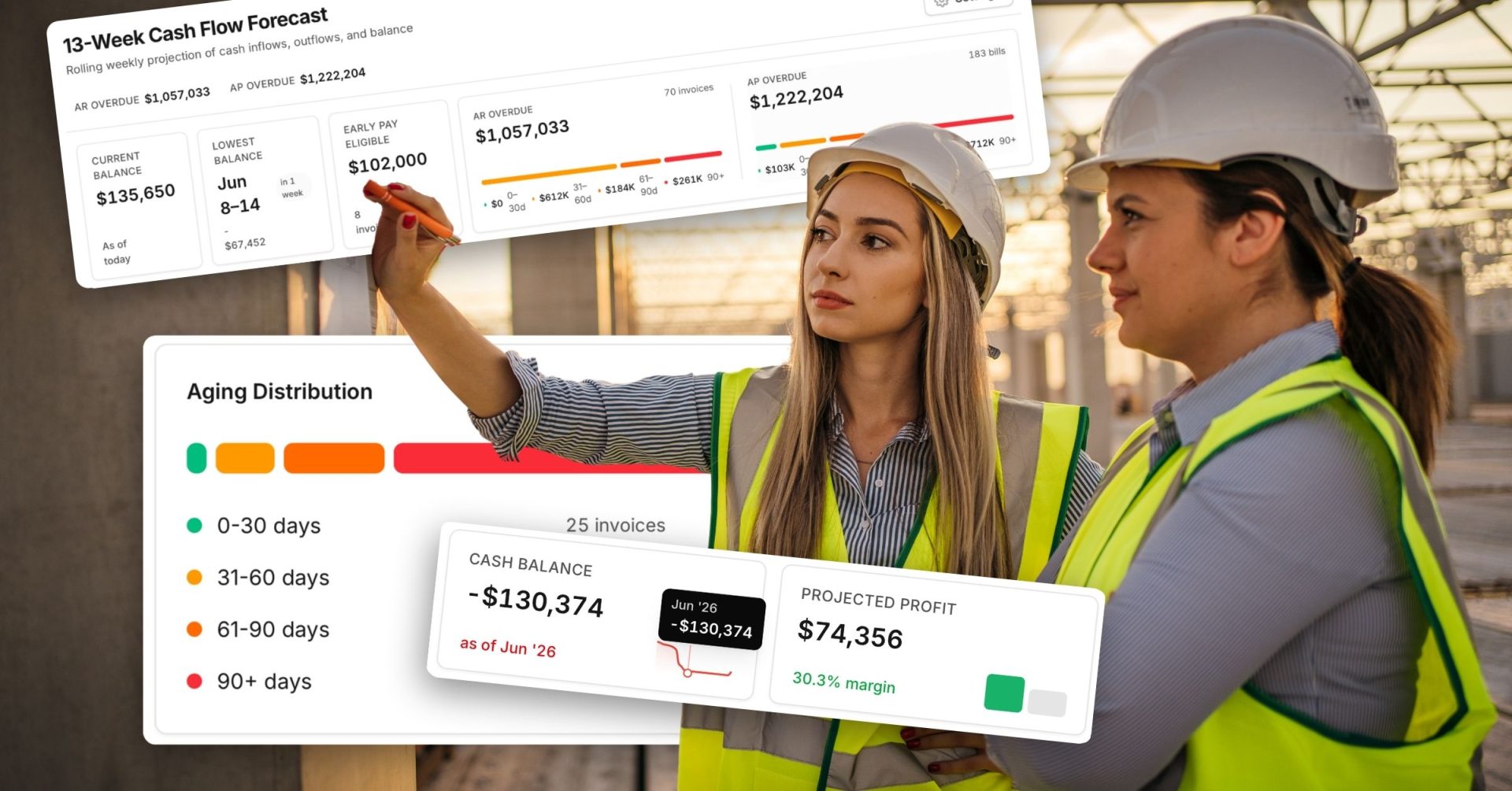
A rolling 13-week cash flow forecast built from historical operating cash flow
Contingency reserves set at 5% of contract value on every job
Billing schedules tied to project milestones, not arbitrary intervals

John O’Bryan
Marketing Manager

2
Pillar Two

Growth Scalability

Construction cash flow isn’t just a survival tool — it determines whether you can grow. In construction, growth isn’t only about winning more work. It’s about being bondable, bankable, and credible to the owners and GCs who award the largest contracts.

Surety underwriters don’t look at your backlog when evaluating bonding capacity. They look at liquidity ratios — specifically the current ratio (assets divided by liabilities) and the quick ratio (cash plus receivables divided by current liabilities). Industry benchmarks put healthy contractors at 1.5 to 2.0 on both. Below 1.0, sureties tend to walk.

A contractor with a strong backlog but a weak quick ratio will lose bonding capacity at exactly the moment they’re trying to move up in contract size. The fix is rarely dramatic. It’s disciplined construction accounts receivable management, phased invoicing, and a line of credit established before it’s needed.

One factor that often gets overlooked: how you access working capital affects your ratios just as much as whether you have it. A bank line of credit, drawn frequently to cover receivables gaps, shows up as utilized debt — and that utilization is visible to sureties and lenders when they evaluate you. An early payment arrangement on approved invoices, by contrast, accelerates cash inflow without adding a liability to your balance sheet or touching your line. That distinction matters when a surety is deciding whether to extend your bonding capacity for a larger project.

The same logic applies to equipment purchases, technology investments, and hiring decisions. Cash flow isn’t just about staying solvent — it’s the financial platform growth runs on.

✓  What it requires
Regular monitoring of current and quick ratios
A receivables management strategy with escalation protocols for slow-paying clients
3
Pillar Three

Risk Mitigation

Construction is a high-exposure industry. Weather delays, change orders, union disputes, material price swings, owner disputes: any one of these can destabilize a project. Without cash reserves and real-time visibility into job costs and receivables, a single disruption doesn’t just affect one job. It triggers a chain reaction.

When cash flow isn’t monitored closely, the consequences compound fast. Vendor checks bounce. Relationships with suppliers deteriorate and future material costs rise as a result. Retainage gets frozen while disputes drag on. Change orders get performed on verbal approval, never logged, never billed, and by the time anyone notices, the margin is gone.

The pattern behind most of these situations is the same: the warning signs were in the data long before anything showed up in the bank account. A job cost report would have flagged the underbilling. A construction AR aging report would have caught the slow-paying client. A cash flow statement would have shown the negative operating cash flow hiding behind a profitable P&L.

This is where technology has meaningfully changed what’s possible. Platforms that integrate directly with a contractor’s ERP can surface a 13-week forward cash position, flag weeks where cash is projected to go negative, and identify specific invoices that could close the gap — all before a crisis develops. The ability to see a problem three weeks out, rather than the day it hits, is the difference between a managed response and a scramble.

✓  What it requires
Cash flow statements reviewed bi-weekly on active projects
AR aging reports with automated escalation triggers
Job cost reports that flag underbilling above 10% of contract value immediately
Change order tracking that connects field approvals to billing and forecasts
Scenario planning every quarter: base case, early payment upside, late payment downside

The Three Pillars Work Together

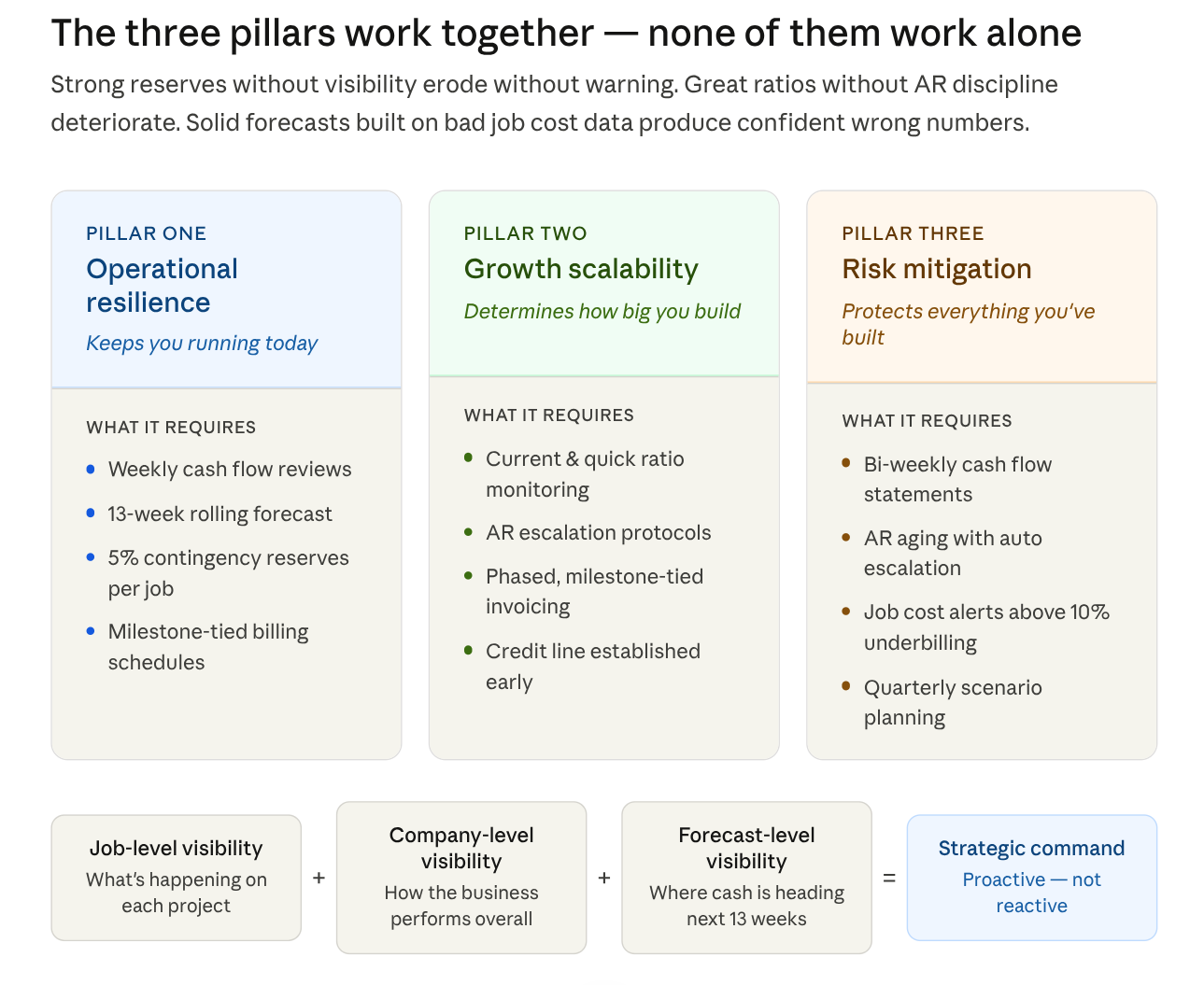
Operational resilience keeps you running today. Growth scalability determines how big you can build tomorrow. Risk mitigation protects everything you’ve built from the threats you can’t fully control.

None of them work in isolation. Strong cash reserves without job-level visibility erode without warning. Excellent liquidity ratios without an AR escalation process deteriorate over time. Thorough scenario planning built on inaccurate job cost data produces confident forecasts of the wrong number.

The common thread is visibility: knowing what’s happening with your cash at the job level, the company level, and the forecast level — consistently enough to act before problems compound.

That’s not a back-office function. It’s the center of strategic command for any construction business serious about growth.

Modern construction financial platforms like ProNovos are built to give contractors exactly that visibility, surfacing the reports, metrics, and alerts that turn construction cash flow management from a reactive scramble into a proactive discipline. See how Jolly Roofing & Contracting cut reporting time from 6 hours to under 1 hour and built a 4–6 week cash flow forecast using ProNovos dashboards. And for contractors who want to close the gap between invoice submission and payment arrival, tools like early payment programs can be connected directly to that forecasting layer, so the decision to use them is informed by data, not gut feel.

The three pillars aren’t complicated. But they do require intention. Contractors who build around them don’t just survive cycles — they dictate them.

You now have the framework. The reports, the metrics, the warning signs to watch. The only question left is how fast you can put them to work.

ProNovos is built to make that easy.

Schedule a Strategy Session →

⚡ QuickPay Direct
Working capital when you need it — not when clients decide to pay
Access funding on approved invoices and keep your business moving forward.
Built for contractors
Close the cash gap
Get paid on approved invoices without waiting for payment cycles to run their course
Strengthen working capital
Keep your current ratio healthy and your bonding capacity intact as you grow
No new debt added
Early payment doesn't touch your credit line or add a liability to your balance sheet
Fund the next job
Put accelerated cash toward mobilization, labor, and materials — not last month's gap