
Rising Interest Rates and Construction: How Subcontractors Can Get Cash Without More Debt
The Fed raised rates in September 2026, and most contractor lines of credit followed. Here’s how subcontractors can compare lines of credit, factoring, and early payment on approved pay apps, with the real cost math and where each option fits.
How rising interest rates hit subcontractors
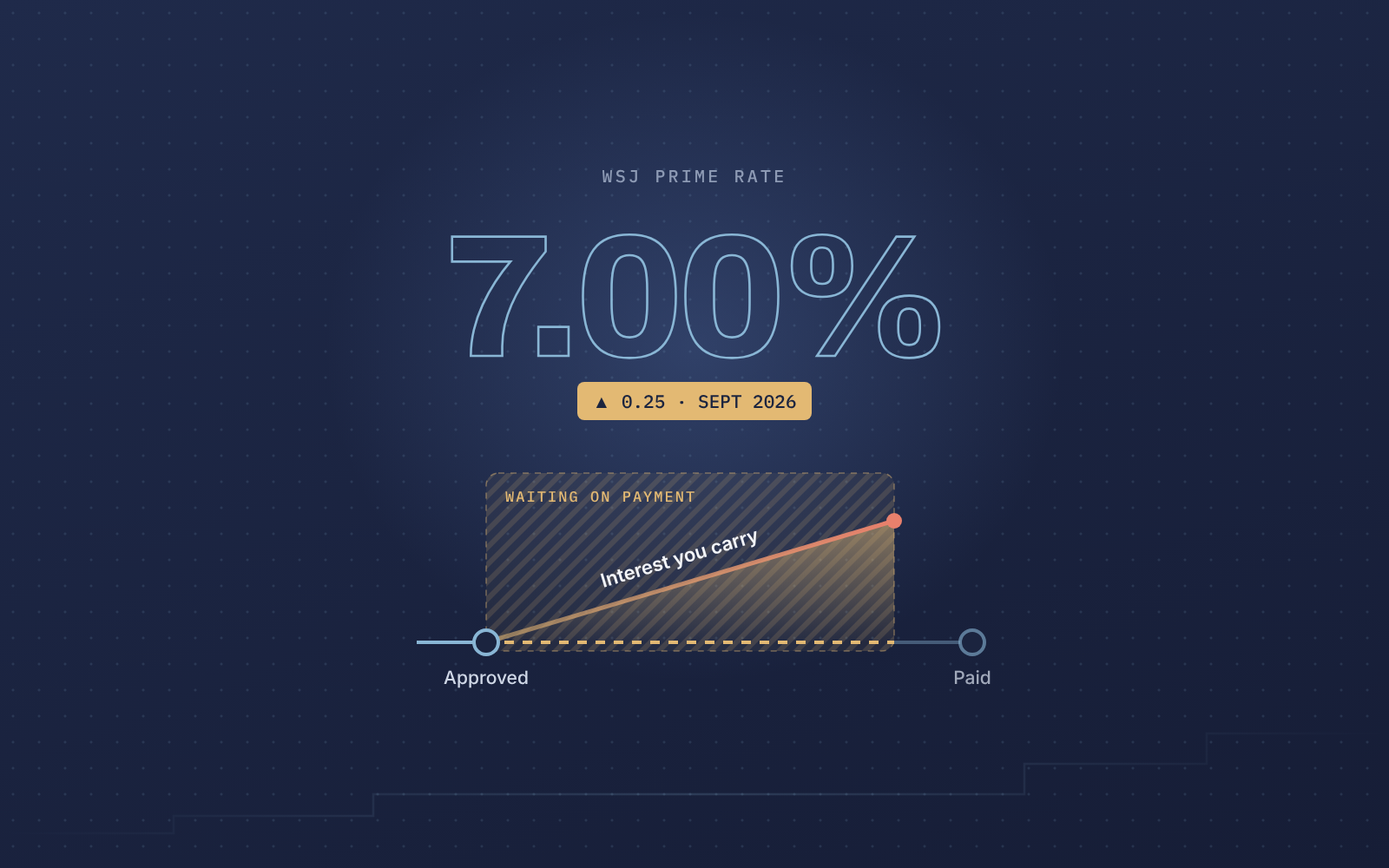
On September 16, 2026, the Federal Reserve raised its benchmark rate by a quarter point to 3.75% to 4.00%, its first increase since 2023. Most contractor lines of credit float with the prime rate, so the cost of carrying payroll and materials between pay apps went up right away.
Subcontractors have four main ways to cover that gap: a bank line of credit, invoice factoring, a term or SBA loan, or an early payment program on approved pay apps. A line of credit is usually the lowest-cost option when you have room. Early payment programs like QuickPay Direct trade a discount for speed and add no debt to your balance sheet.
What changed in September 2026
Borrowing got more expensive, and so did materials. Here is where the key rates stood in late September 2026.
The lender ranges are indicative quotes compiled by Terrapin, not a survey. Your rate depends on your bank, your financials, and your guarantees.
Three things matter for contractors:
Floating lines reprice now. A line priced at prime plus a spread costs more starting with the next interest period. On a $500,000 average balance, each 0.25-point increase adds about $1,250 a year in interest.
Costs are rising too. Nonresidential construction input prices were up 8.9% year over year in August, according to Construction Dive, citing Producer Price Index data. You may need to borrow more just to buy the same materials.
More hikes may follow. ConstructConnect chief economist Michael Guckes told Construction Dive he expects more increases, and warned that some owners may delay or drop projects. That can leave subs holding costs they have not billed.
Rates change often. Check current prime and your own line's terms before you act on these figures.
Why subcontractors feel it first
Subs pay for labor and materials weeks before the money comes back. A sub bills at month-end, waits for the GC to get paid by the owner, then waits again for the GC to pay. Retainage holds back part of every payment until the job closes out. Every day of that wait costs you cash or line of credit.
When rates rise, that wait costs more. When materials rise too, you finance a bigger number for the same wait. And banks often tighten when rates go up. They may ask for more financial reporting, cap your borrowing base, or say no to an increase. See why banks turn down line of credit increases.
GCs and owners often have more financing options than the trades working for them. That is why the squeeze shows up at the sub level first.
Your options compared
No single option fits every gap. Most subs use more than one.
A line of credit still matters. Sureties and banks look at your available credit. Early payment works best next to a line, not as a full replacement for one.
How to compare the cost
Interest and discounts are priced differently, so compare them in dollars for the same amount and the same number of days.
Example (illustration only, made-up figures)
A sub has a $100,000 approved pay app and expects to wait 45 days for payment.
In this example, the line is cheaper per dollar. The early payment option costs about $452 more, and in return the sub adds no debt, uses none of the line, and needs no bank approval. If the line is maxed out, the bank says no, or the sub wants to keep the line open for something else, that trade can be worth it.
This is general information, not financial advice. Talk to your CPA or banker about your situation.
See if QuickPay Direct is Right For You
Where QuickPay Direct fits
QuickPay Direct lets subcontractors turn approved pay apps into cash without waiting on the GC's payment cycle. It is early payment at a discount, not a loan, so it does not add debt.
How it works:
Your pay app is approved.
In your free Nova portal, you pick which approved invoices to accelerate.
You see what you will receive before you commit.
Viva Capital funds the program. Your contract, scope, and retainage remain unchanged.
Your GC is never notified.
Why it fits a rising-rate market:
It does not reprice with the Fed. The cost is a discount you see up front, not a floating rate.
It keeps your line open. You can hold your line for costs you have not billed yet, like payroll and materials at the start of a job.
No bank approval. It does not depend on your borrowing base or a line increase.
You choose. It is invoice by invoice, not all or nothing.
Speed. Once your invoice is approved, you will receive the funds on the next business day.
What it does not do: it does not fund work before a pay app is approved, and it does not release retainage early.
See what you would receive on your next approved pay app.
FAQ
How do rising interest rates affect subcontractors? Most contractor lines of credit float with prime, so interest costs rise soon after a Fed hike. Subs carry labor and material costs between billing and payment, so they feel higher borrowing costs quickly.
What is the prime rate in October 2026? The WSJ prime rate was 7.00% after the Fed's September 16, 2026, increase. Check a current source before relying on it, since it moves with Fed decisions.
What are the alternatives to a line of credit for subcontractors? The main options are invoice factoring, term or SBA loans, early payment programs on approved pay apps, and negotiating better payment terms. Each has different costs, speeds, and effects on your balance sheet.
Is early payment on a pay app the same as factoring? Not always. With QuickPay Direct, the sub chooses approved invoices to accelerate, the GC is not notified, and ProNovos describes it as early payment at a discount, not a loan. Factoring terms vary by provider and often include notifying the customer.
Is early payment cheaper than a line of credit? Often not, especially when you compare it on a per-dollar-per-day basis, and your line has room. Early payment can still be the better choice when you want to avoid new debt, your line is maxed, or you need cash without bank approval.
Should I drop my line of credit? Usually no. A line covers costs before you bill, and sureties and banks look at available credit. Early payment works best alongside a line.
See what an approved pay app is worth today
If rates keep climbing, the cheapest dollar is the one you do not have to borrow. Use your line for costs you have not billed yet. For approved pay apps you are waiting on, see what early payment would cost before you draw.
See what you would receive on your next approved pay app.