
Balance Sheet Basics for Construction Industry Professionals
Profitable on paper but still short on cash? The answer is usually on your balance sheet. This guide breaks down every account on a construction balance sheet, from retainage to earnings in excess of billings, with a full worked example and the KPIs sureties watch, so you can see exactly where your money is tied up and whether your company is financially healthy.
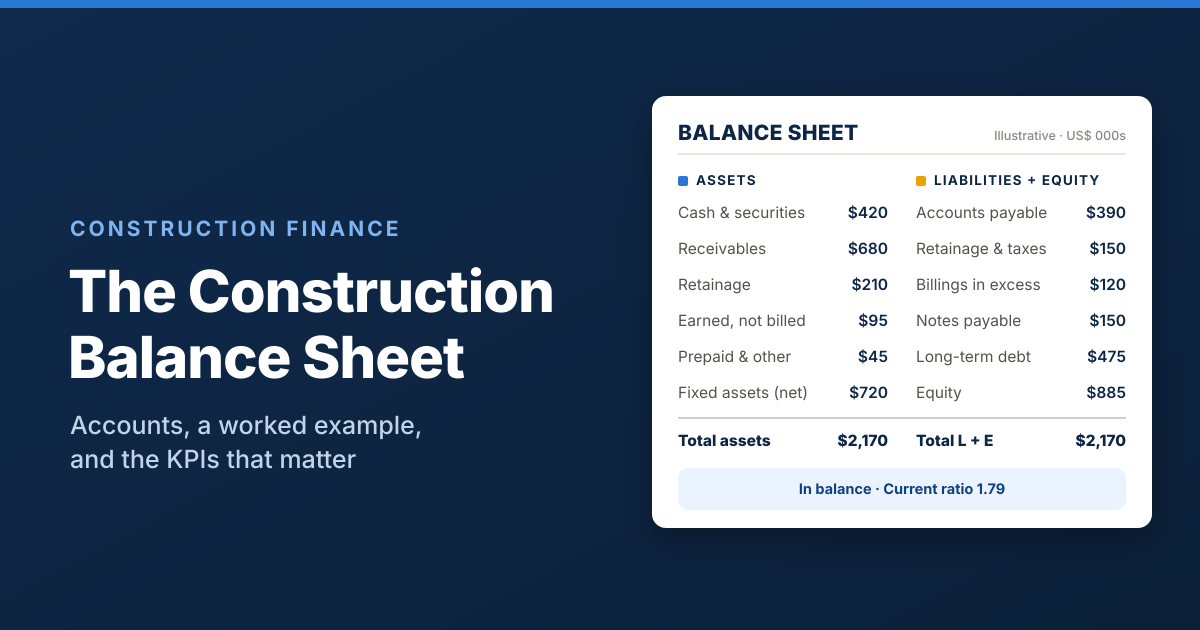
Navigating a balance sheet is no small feat, especially for professionals in a construction company who may not have a deep accounting background. But the ability to read this document matters for anyone running a contracting business. It is one of the three core financial statements every company produces, alongside the income statement and the cash flow statement, and it is home to many of the KPIs that reveal the financial health of your business.
This guide is built for people whose expertise is in building projects rather than crunching numbers, bridging the gap between construction know-how and financial fluency.
Why is my construction company profitable but still short on cash?
Profit is not cash. On the balance sheet, your money is often locked up in accounts receivable, retainage receivable, and earnings in excess of billings, which is work you have completed but not yet invoiced. A profitable job can still starve you of cash when billing lags behind costs. Reading the balance sheet alongside your WIP report and cash flow statement shows where the cash actually sits.
What is a construction balance sheet?
A construction balance sheet is a snapshot of a contractor's financial position on a specific date. It lists three categories of accounts pulled from the general ledger: assets, liabilities, and equity. Assets and liabilities are each split into current (convertible to cash or due within about 90 days) and long-term (more than 90 days).
The defining feature of a construction balance sheet is the project-driven accounts it carries, such as retainage, earnings in excess of billings, and billings in excess of earnings, which tie directly to how contractors recognize revenue across long project cycles.
What are the asset accounts on a construction balance sheet?
Assets represent everything a company owns or controls that has present or future economic value. For contractors, assets are what make it possible to deliver on projects.
Current assets
Cash and securities: The most liquid assets, including cash on hand, bank balances, and short-term investments like treasury bills that convert quickly to cash.
Accounts receivable: Amounts clients owe for work that has been invoiced but not yet paid.
Inventory: Raw materials bought for projects, costs tied to work in progress, and completed work awaiting delivery.
Earnings in excess of billings: Revenue recognized for work completed that has not yet been invoiced. It means the earned value on a project exceeds the amount billed.
Retainage receivable: A portion of the contract price your client withholds until the work is finished to their satisfaction.
Prepaid expenses: Costs paid in advance for goods or services received later, such as insurance premiums for future coverage periods or upfront supplier payments.
Other current assets: A catch-all for short-term items like refundable deposits, expected tax refunds, or short-term loans to employees.
Fixed assets
Property and plant: Land and buildings the company owns, such as offices, warehouses, and yards. These are depreciated over their useful lives, except land, which is not depreciated.
Equipment: Machinery, vehicles, and other gear used on projects, including cranes, excavators, and trucks, depreciated over their expected useful life.
Accumulated depreciation: A contra-asset account that totals all depreciation recorded over time, reducing the book value of fixed assets to reflect wear and obsolescence.
Other fixed assets: Long-term tangible items that do not fit elsewhere, such as furniture, fixtures, and leasehold improvements, also depreciated over their useful lives.
What are the liability accounts on a construction balance sheet?
Liabilities are what the company owes. Current liabilities are typically due within a year, and long-term liabilities extend beyond it.
Current liabilities
Notes payable: Written promises to pay set amounts on demand or by a future date, usually short-term borrowing for immediate operating needs.
Accounts payable: Amounts owed to suppliers and subcontractors for goods and services already received, such as materials or subcontracted work.
AP retainage (retainage payable): The portion of subcontractor or supplier payments you withhold until a project hits agreed milestones or completion.
Billings in excess of earnings: When you have invoiced a client for more than the value of the work completed to date. It represents an obligation to either finish the remaining work or adjust the billing.
Tax payables: Amounts owed to governments, including income, sales, payroll, or industry-specific taxes.
Other current liabilities: A catch-all for accrued wages, interest payable, and other short-term obligations.
Long-term liabilities
Mortgages: Loans secured against real estate the company owns, with repayment terms beyond one year.
Equipment and vehicle financing: Loans used to acquire equipment and vehicles over time, with the asset itself serving as collateral.
Other long-term liabilities: Obligations due beyond one year that do not fit the categories above, such as bonds payable, deferred tax liabilities, or long-term leases.
What is equity on a construction balance sheet?
Equity is the ownership stake in the company, or the residual value once all liabilities are subtracted from assets. It signals financial health, stability, and investor confidence.
Retained earnings: Cumulative net income the company has kept and reinvested rather than distributed to shareholders. A positive figure points to profitability over time; a negative one suggests accumulated losses.
Shareholder distributions (dividends): The share of profits paid out to owners. Many contractors retain earnings for growth or debt repayment rather than distributing them.
Common stock: Ownership shares in the company, recorded at par value, with anything received above that logged as additional paid-in capital. Issuing stock raises capital for large projects without taking on debt.
What makes a construction balance sheet different?
Construction accounting reshapes the balance sheet in ways most industries never deal with:
Work-in-progress (WIP) reporting: WIP schedules track the costs and revenues of active jobs and feed directly into balance sheet accounts.
Percentage-of-completion method: Revenue and costs are recognized as projects advance, creating project-specific assets and liabilities.
Over- and underbillings: Revenue recognition is complicated by billings that run ahead of or behind earned value, adjusting both receivables and liabilities. See more on managing over and underbillings in construction.
Retainage: Withheld payments appear as both receivables and liabilities and can tie up significant cash across multiple jobs.
Bonding, surety, and insurance: Premiums and obligations create their own adjustments.
Job costing and change orders: Shifts in project scope and cost flow through accounts payable, receivable, and costs.
What does a balance sheet actually look like for a contractor?
How do you prepare and review a construction balance sheet?
Preparation and review usually move through three stages, each adding a higher level of assurance.
Internal preparation: Gather and record all transactions, update WIP schedules, and confirm accurate job costing. Reconcile bank accounts, verify receivables and payables, update depreciation, and post adjusting entries for accruals, deferrals, and retainage. Compile an initial balance sheet and a trial balance to catch discrepancies.
CPA review: A certified public accountant verifies the internally prepared statement, reviews supporting documents, makes corrections, and issues a review report. Sureties often want this level of assurance.
CPA audit: An external CPA firm examines the balance sheet in depth, tests internal controls, verifies transactions, and issues a final audit report. Post-audit, the team addresses findings and strengthens financial reporting.
Frequently asked questions
What is the difference between a balance sheet and a WIP report?
A balance sheet gives a snapshot of your company's overall financial position (assets, liabilities, and equity) at a single point in time. A WIP report is project-level: it tracks costs incurred, revenue earned, and over- or underbillings across active jobs. The two are closely connected, because your WIP report feeds balance sheet line items like earnings in excess of billings and billings in excess of earnings.
How does retainage appear on a construction balance sheet?
Retainage shows up in two places. Retainage receivable (amounts your clients withhold from you) sits in current assets. Retainage payable (amounts you withhold from subcontractors) sits in current liabilities as AP retainage. Both can be significant on large projects, and retainage tied up across multiple jobs can create real cash flow pressure.
What is a good current ratio for a construction company?
Most construction financial advisors and sureties look for a current ratio of at least 1.3 to 1.5, meaning current assets exceed current liabilities by 30 to 50 percent. A ratio below 1.0 is a red flag that the company may struggle to meet short-term obligations. The quality of those current assets matters as much as the ratio itself. Learn more about good versus bad working capital in construction.
How often should a construction company review its balance sheet?
At minimum, quarterly. High-growth contractors and those with active bonding relationships should review it monthly. Monthly reviews let you catch deteriorating KPIs like a rising DSO or a declining current ratio before they turn into problems.
What financial statements should be reviewed alongside the balance sheet?
Pair the balance sheet with the income statement to understand profitability and the cash flow statement to track actual cash movement. A company can post strong profits while still running out of cash, so reviewing all three together gives you the complete picture.
Turning your balance sheet into a decision-making tool
For construction businesses, the real value of a balance sheet is not in preparing it but in reading it continually. Regularly monitoring KPIs like the cash conversion cycle, fixed asset ratio, and days sales outstanding, and benchmarking them month over month, is what keeps a contractor financially sound and positioned for growth.
Nova, the AI financial intelligence assistant from ProNovos, surfaces more than 20 critical balance sheet KPIs in real time and lets you filter performance by month, quarter, and year, so you are not waiting on a month-end close to see where you stand. Book a Nova walk-through to see it against your own numbers, or start a 7-day free trial and sync your ERP data to get a live read on your financials.
If you are evaluating your broader accounting setup, it is also worth reviewing the top construction accounting software contractors rely on today.