
Why the “Do-It-All” ERP Is a Myth in Construction
Last fall, I spent a lot of time on the road speaking at CFMA regional conferences and the AICPA Construction and Real Estate Conference. In conversation after conversation, one theme kept coming up.
Last fall, I spent a lot of time on the road speaking at CFMA regional conferences and the AICPA Construction and Real Estate Conference. In conversation after conversation, one theme kept coming up.
Construction professionals are frustrated with their ERP.
What I kept hearing was not that their ERP was failing. It was that it was not doing everything they needed it to do. There is an expectation that an ERP should be an end-to-end solution that handles every process, every report, and every workflow across the company.
That expectation is the real problem.

What ERPs Are Actually Built to Do
At its core, an ERP is meant to help a company manage and integrate essential business processes, especially finance, by keeping information in a central system and providing a shared view of activity.
In construction, many teams use the ERP primarily as the system of record for accounting and job cost. It does a solid job of collecting financial data and supporting standard reporting, but it is not designed to anticipate every unique workflow, every role’s needs, or every format leaders want for decision-making.
That gap shows up quickly in construction because companies do not operate in a single “standard” way. Reporting expectations and operational processes vary widely by contractor type, project mix, risk profile, and leadership style.
Option 1: The End-to-End Suite Approach
What it is:
You select a primary platform, typically an ERP suite (or ERP plus tightly integrated modules), and you aim to keep most functions inside that ecosystem.
Pros
Fewer vendors and contracts to manage
Built-in integration between modules, usually a common data model, and a consistent user experience
Lower integration complexity up front, fewer connectors to maintain
Cons
Depth varies by module. Some areas may be strong, others may be “good enough.”
Product roadmaps are shared. Improvements in your most critical area compete with priorities across the full suite.
You may end up changing your processes to fit what the software supports, rather than the other way around
Option 2: Best-of-Breed Tools Connected to Your ERP Through APIs
What it is:
You choose a stable ERP as the system of record, then add specialized tools for forecasting, analytics, project performance, field workflows, or executive reporting. Those tools connect back to the ERP using APIs and integrations.
Pros
Purpose-built functionality in the areas where you need real depth
More flexibility to evolve your tech stack as your business changes
Better fit by role. Teams use tools designed for how they work, instead of forcing everyone into one interface
Cons
Integration strategy matters. Without a plan, you can create messy data flows and confusion about what is “true.”
Implementation can take longer because connecting systems and defining governance is real work
Ongoing ownership is required for data governance, vendor management, and process alignment
Why One Platform Will Never Do Everything Well
Here is the simplest way to think about it.
Do you know of a construction company that can serve as a GC, electrical contractor, concrete contractor, heavy highway contractor, and painter, all at the same level of expertise?
Most of us would say no, because specialization exists for a reason. Every trade has depth that takes focus, process, and repetition to master.
Software works the same way. When a single system claims it can cover accounting, operations, forecasting, analytics, field workflows, payroll, and executive reporting equally well, something becomes shallow. Breadth almost always comes at the expense of depth.
Top Construction Accounting Software's
Compare leading construction accounting and ERP platforms, with a neutral look at tools commonly used by contractors today.
A Practical Framework for Selecting the Right Approach
Instead of asking, “Does this ERP do everything?” ask these questions:
System of record:
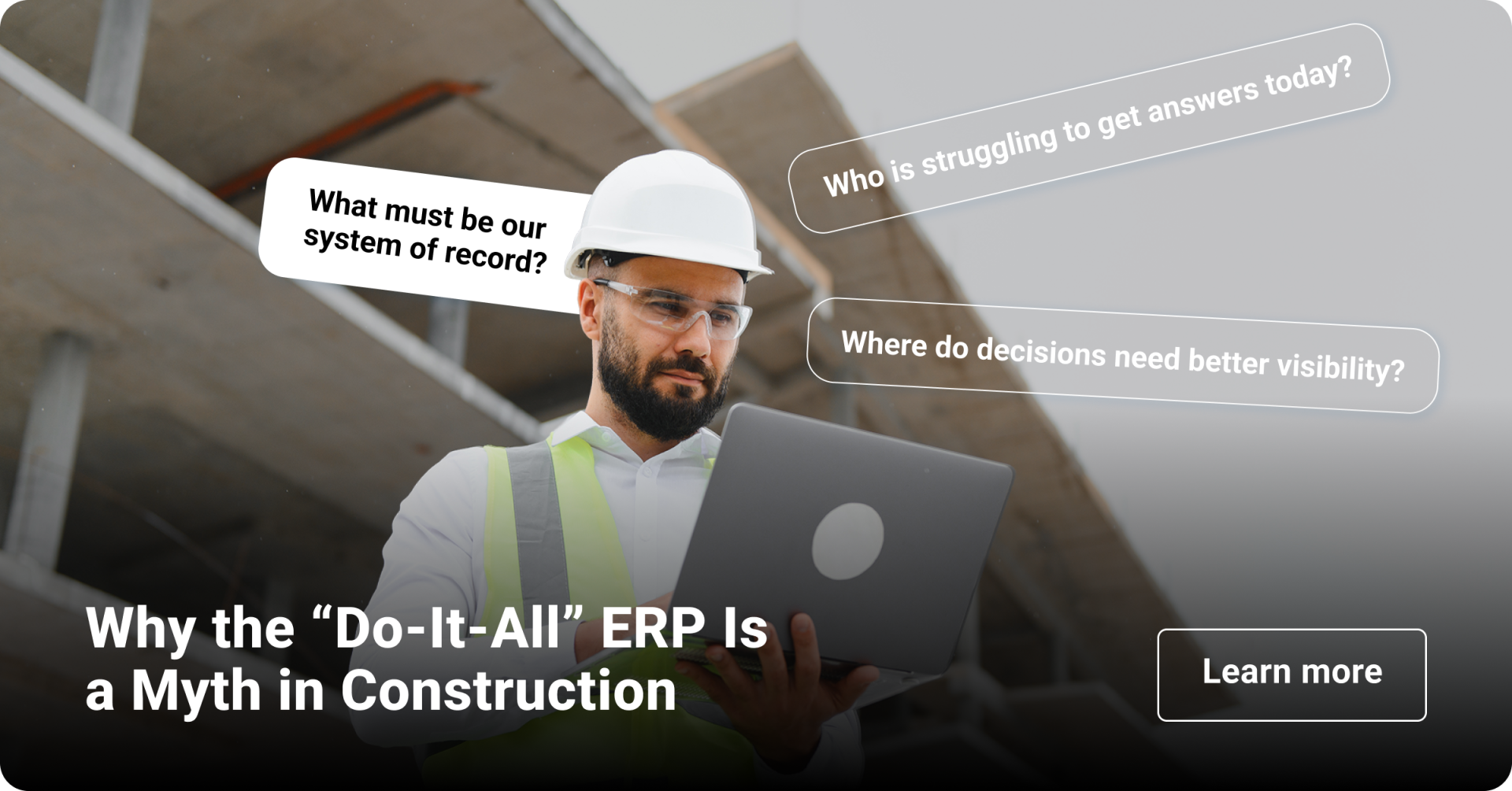
What must be our system of record? For most contractors, that remains the ERP for finance and job cost.
Visibility:
Where do decisions need better visibility? Cash flow, WIP quality, forecasting, labor productivity, and project risk typically top the list.
Who needs answers:
Who is struggling to get answers today? If PMs, ops leaders, and executives need different views than accounting, you likely need tools beyond standard reports.
Suite vs. best-of-breed:
Do we need a suite for simplicity, or best-of-breed for depth? Suites reduce vendor complexity. Best-of-breed can deliver deeper capability in critical areas.
Integration readiness:
Can our ERP connect cleanly to other tools? Prioritize data access, integrations, and API maturity because that is what makes a tech stack workable over time.
Actionable Takeaways
Stop shopping for a mythical all-in-one ERP. It is not a realistic bar in construction.
Treat your ERP as the foundation. It should remain the system of record, not the finish line.
Decide where you need depth. Then add purpose-built tools in those areas.
If you go best-of-breed, plan the integration. Invest in integration planning and data governance upfront. It will save you pain later.
Measure success by outcomes. Look for fewer surprises, earlier visibility into risk, and faster decisions with confidence.
Schedule Your Meeting Now
Sources
The concepts and definitions referenced in this article are informed by the following sources: