To Build or Not to Build: A Question I Didn't Expect to Find at the Globe
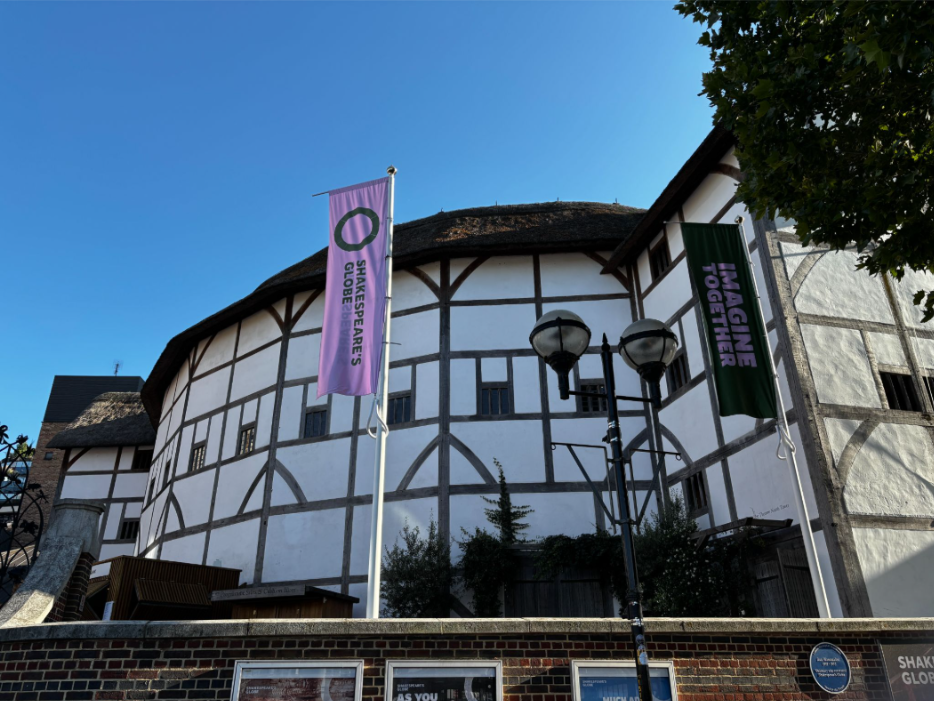
Standing in front of Shakespeare's Globe, Hamlet's most famous question turned into a software question: build your own AI financial tool, or buy one that already understands construction finance?

A few weeks ago, our CEO Bruce Orr walked through the real costs contractors run into when they try to build their own AI financial tools in-house: the data integration headaches, the missing construction accounting expertise, the maintenance that never really ends. It's a conversation we have on nearly every discovery call, and it's worth reading if you haven't already.
I wanted to come back to that same question, but from a different angle, because of where I happened to be standing when it hit me again.
I was in London a few weeks ago. I was on the Thames River, standing in front of the Globe Theatre, the reconstructed version of the playhouse where Shakespeare's own company performed four hundred years ago. I heard Hamlet saying, "To be, or not to be, that is the question: whether 'tis nobler in the mind to suffer the slings and arrows of outrageous fortune, or to take arms against a sea of troubles, and by opposing end them."
Hamlet is wrestling with life and death. I was thinking about software.
The same choice, four hundred years apart
Strip away the mortality and Hamlet's dilemma is really a decision every contractor eventually faces with technology: do you endure a known, bearable discomfort, or do you take on an unknown, possibly larger one in exchange for control?
The dilemma you are facing is build versus buy,
Building your own AI financial tool is "taking arms against a sea of troubles." It sounds active, even heroic. You get exactly what you want, eventually. But you're the one in the water: figuring out how retainage actually behaves, how AR aging really works, why your AI model is confident and wrong at the same time, how to keep syncing cleanly with your ERP every time either one pushes an update. None of that is a weekend project. It's months, sometimes years, of your team's time, money, and attention, spent solving problems a specialized vendor already solved.
Buying a solution that's built for construction finance but isn't a perfect, bespoke fit is "suffering the slings and arrows." It's the less dramatic option. The discomfort here isn't technical; it's organizational: you adjust a workflow, you retrain a habit, you accept that the tool won't bend itself entirely to how you've always done things. That's a real cost. It's just a smaller and more predictable one than the alternative.
Hoist with his own petard
There's another line from Hamlet that I think about even more, actually, when it comes to the build option.
Later in Hamlet, the prince plots to turn his enemies' own trap back on them, and describes the satisfaction of watching "the enginer hoist with his own petard." A petard was an explosive device. The phrase has come to mean getting blown up by your own bomb.
That's the quiet risk of building in-house that doesn't show up in the kickoff meeting. The tool you build to solve today's problem is also the tool your team now has to defend, patch, and babysit for as long as it exists. Every ERP update becomes your update. Every new integration is your integration. The thing you built to save time can end up being the thing that quietly consumes it, and the person who understands how it all works is often one or two people deep. That's not a hypothetical. It's the pattern we hear about on nearly every one of those discovery calls..
What the data says, not just the Danish prince
I don't want to lean only on four-hundred-year-old verse here, so I'll add something more current. In an early read of our own 2026 AI survey of construction finance leaders (a smaller sample so far, so I'd treat this as directional rather than final), integration with existing systems was the top-cited factor construction companies weigh when evaluating new technology, named by roughly three out of every four respondents. Lack of internal AI expertise was the single most-cited barrier to adoption, well ahead of budget. Those two numbers together are basically Hamlet's soliloquy translated into a bar chart: the fear of the unknown, and the fear of the sea of troubles, both showing up in the same data.
The readiness is all
Hamlet spends most of the play unable to act, paralyzed by wanting certainty before he'll move. By the end, he lands somewhere calmer: "the readiness is all." Not certainty. Readiness.
I think that's the healthier way to hold this decision. You don't need to solve every unknown before you choose a path, and you're not going to get a version of either option with zero discomfort. The question isn't which choice is pain-free. It's which discomfort you'd rather carry: the sea of troubles of building it yourself, or the slings and arrows of adjusting how you work to a tool that already understands construction finance.
For us, and for most of the contractors we talk to, that second discomfort is a lot easier to live with. But I'll admit, it's a better question standing in a wooden theater in London than it ever was in a vendor evaluation meeting.